


Let us not be lukewarm! – Mouvement NATION interview with László Kolonits

A few days ago, one of the leaders of our movement, the editor-in-chief of Duo Gladii, gave an interview to one of the member organizations of the International Sovereigntist League (ISL Paladins), our Belgian ally, Mouvement NATION. The interview covers the history of the Movement, its spirit, its foreign relations, and, as an outlook, the current political situation.

Could you introduce yourself?
My name is László Kolonits, and I am a board member of HVIM – Hungarian Resistance. In this capacity, I serve as editor-in-chief of DuoGladii – The Journal of Spiritual Resistance, a print-only journal of worldview published by the Movement. I also coordinate the Movement’s international relations. I consider it important to emphasize that, in addition to other roles, I regularly participate as a speaker at our youth education events.
Regarding my civilian qualifications, I am a historian, cultural manager, and archaeologist specializing in prehistoric and classical archaeology. I have been working in archaeology for more than twenty years. Currently, I serve as deputy head of the archaeology department at a museum, curator of the prehistoric collection, and as a heritage expert.

Could you tell us about your movement, its history, and its ideology?
HVIM was founded exactly twenty-five years ago, born out of outrage over the injustice of the 1920 Treaty of Trianon and the Paris Peace Treaties signed in 1947. These treaties detached sixty percent of the population of the Kingdom of Hungary and more than two-thirds of its territory, including regions that had belonged to the heartland of Hungarian culture.
The immediate context of the Movement’s founding in 2001 was that, during the communist era, it was impossible to speak openly about this national trauma, which tore apart a thousand-year-old organic empire and ruined the lives of millions. Unfortunately, these old, negative reflexes did not disappear after the regime change in 1989. As a result, Trianon remained a taboo subject for another decade and a half.
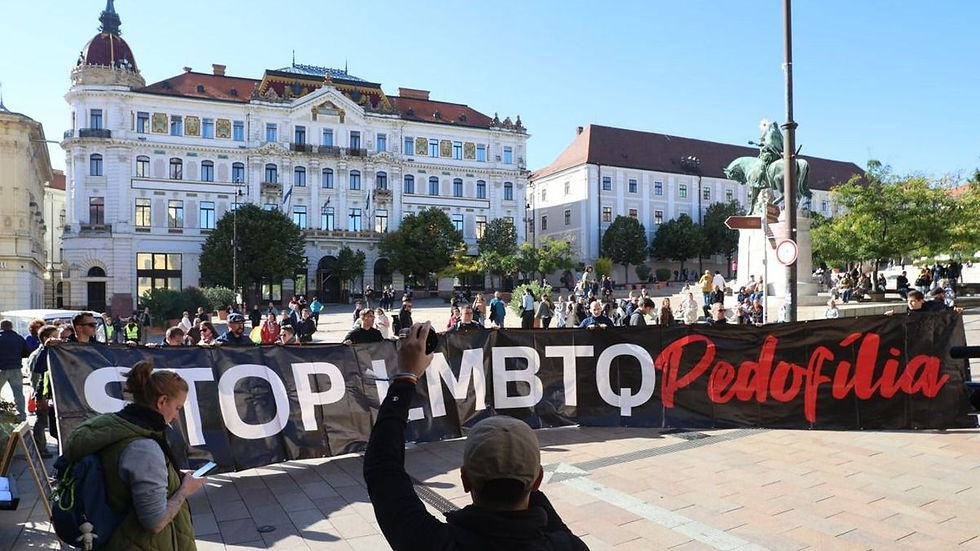
Since the founding, our focus has shifted. The times demand that we turn our attention even more decisively toward the forces of destruction. Much of our energy today is devoted to resisting left-wing, liberal, materialist, and atheist subversive forces, woke ideology, and the local agents of the LGBTQ lobby. While our role in other areas remains significant in today’s Hungary, we play a central role in opposing the gender lobby, which we see as the avant-garde of subversion.

That said, our activities go far beyond mere reactive opposition to the satanic tendencies of our age, whether in the form of street activism or otherwise. We maintain a number of institutions. In addition to our online media platforms, we publish a bimonthly print magazine titled DuoGladii. We organize historical commemorations and run a series of hiking tours. We also have a unit called Farkasok (Wolves), which teaches and practices martial arts and survival skills in nature.
Perhaps our most important area of activity is youth education. In this framework, we organize children’s and youth camps, as well as educational and training weekends. In effect, we train our own recruits. We seek to revive traditional ideals among the young people who come to us, and one of our primary goals is to cultivate a new intellectual elite.
Ideologically, we aim to revive pure, traditional right-wing politics—the worldview that was entirely commonplace in Europe and much of the world before the French Revolution. As Julius Evola stated: “My principles are only those that, before the French Revolution, every well-born person considered sane and normal.” We consider ourselves the spiritual heirs of Rome and the steppes, as well as the custodians of Saint Stephen’s empire.
One of our organization’s primary role models is the Knights Templar, but we also embrace the traditions of the White counterrevolution and the legacy of 1956. Among modern political movements, Falangism, the Conservative Revolution, and the legionary spirit are perhaps closest to us. However, we do not copy any of them. Our aim is not to anachronistically resurrect bygone eras. We do not follow our ancestors themselves, but rather what our ancestors followed.
Our spirit is rooted in Tradition and founded upon vital, medieval militant Christianity. HVIM – Hungarian Resistance is monarchist, we regard democracy as spiritless and anti-spiritual, and therefore reject it. We value theistic thought, respect for ritual, masculine virtues, the preservation of virility, the combative kṣatriya spirit, and respect for hierarchy. Our ideal is the establishment of a system of rule by the best (aristoi), selected on meritocratic grounds.

What is your position on the political situation in Hungary? What do you think of Orbán?
Viktor Orbán is a highly talented politician. I am convinced that the power techniques and political system he has built and operated for more than a decade will soon be taught in most university political science departments. However, his intentions are not pure, and there are numerous problems with Fidesz, which he controls with an iron fist.
The organization began with a purely liberal spirit before the 1989 regime change, with the broad support of the Soros Foundations, and then suddenly turned to the right, while its leadership and core membership remained nearly unchanged. The reason for this shift is clear: Orbán sensed the changing winds, recognized an opportunity, and decided that instead of remaining just another liberal party leader, he would position himself as the central figure of what was then a still peripheral European right wing. This shift should therefore be understood not as a sincere conversion, but as opportunism.
Despite its undeniable merits and certain trends that can be viewed as positive when compared to developments in the Western world, Fidesz appropriates popular right-wing themes but implements them only superficially, in a form that remains marketable for propaganda purposes. In doing so, it constructs a right-wing Potemkin village. This process drains many important issues of their substance and blinds the masses, who are uninterested in deeper understanding and therefore believe that everything is fine—when in fact, many things are not.
Officially, there is no immigration in Hungary today, yet the streets are full of guest workers from the Philippines, Kenya, Mongolia, and elsewhere. We are told that they will return home, but we see little chance of that happening. The longer they remain, the less likely their departure becomes.
Even more dangerous, in our view, is that Fidesz has entered into a pact with Atlanticist-Zionist circles. They maintain fraternal relations with Israel’s Likud party and consistently vote in the United Nations as Israel’s most loyal and unconditional supporters, alongside the United States. They are also embedded in the network organized around CPAC, whose emblematic figures include Donald Trump (and Jared Kushner), Benjamin Netanyahu, Jair Messias Bolsonaro, Javier Milei, Marine Le Pen, and Giorgia Meloni, alongside Orbán. In addition, the Chabad–Lubavitch Jewish sect has appeared in Hungary and is closely linked to Fidesz.
Looking ahead to the parliamentary elections scheduled for April 12, 2026, Fidesz will face a very strong challenger for the first time in many years—one backed by ultra-liberal agents of globalist big capital seeking to regain control over Hungary. In our view, the only good choice is the Mi Hazánk (Our Homeland) party, which sincerely represents the national interest and, based on current power relations, is the only party besides the two major blocs that is likely to enter the Hungarian parliament.

Your organization is a member of an international association called the International Sovereigntist League. Why did you join this?
Although the Magyar Sziget (Hungarian Island) event, organized by our Movement year after year for many years, played a catalytic role in the rebirth of the Hungarian—and to some extent the European—right wing, for a time we were only able to devote limited attention to foreign relations. Eventually, however, we recognized that alongside the struggles waged within Hungary, it was essential to build supranational networks. Against international networks, only limited results can be achieved within the framework of the nation-state alone.
In 2022, we participated in a conference organized in Rome by the Italian Militia Christi. Among several other organizations, the foreign affairs representative of the Brotherhood of Academists (Bratstvo Akademistov) delivered a presentation online due to the global situation at the time. Following this, we established contact and discovered that we share a very similar worldview. Monarchism, adherence to White counterrevolutionary traditions, and a foundation in Christianity provided a common ideological ground. A few years later, discussions began about forming an international alliance, which ultimately resulted in the creation of the ISL Paladins.

Isn’t it difficult to participate in this League alongside Russian nationalists, given the memory of 1956 and the repression of the Hungarian people by the Red Army?
We believe that the occupation of Hungary in 1944–1945 and the suppression of the 1956 revolution were not rooted in the Russian people or their natural imperial ambitions, but rather in stateless communist Soviets who were thinking in terms of world revolution. The intellectual predecessors of our Russian allies, the Brotherhood of Academists were oppressed by the communist system just as the Hungarian people were. In this respect, we consider ourselves brothers, too. There is no direct equivalence between the Soviet Union and today’s Russia. Of course, we condemn the communist nostalgia that is emerging in certain Russian circles, but our Russian allies share our view on this issue. Consequently, we see no contradiction here that requires resolution.

Do you have a message for our readers in Belgium?
Our most important message to the Belgian people—and to all European nations—is this: dare to stand up for the truth! Very often, simply demonstrating values can trigger effects that push broader trends in a positive direction. It also sets an example for the masses, who might otherwise suffer in silence from processes that are hostile to them. As the Book of Revelation (3:15–16) states: “I wish you were either cold or hot. So, because you are lukewarm, neither hot nor cold, I will spit you out of my mouth.” Let us not resign ourselves to the turmoil engulfing the traditional world! Let us not be lukewarm!


